The House
The story of Paul Sagoo OBE — and why a house of colour exists at all.
Why a house of colour
Fifteen years of black-tie taught him one thing: the room remembers the person who didn't wear black.
For years, Paul's evenings were spent in ballrooms — a sea of dinner jackets, every one of them black. The awards he founded honoured the boldest people of a generation, and they all arrived dressed identically. Somewhere between the red carpets and the podiums, an idea settled: the world doesn't lack for luxury. It lacks for colour with the confidence to be worn.
Eyewear was the deliberate choice. It sits in the one place nobody can miss — on your face, at eye level, in every photograph and every hello. A watch hides under a cuff; a pair of frames introduces you before you speak. So the first products of the house are the ones that meet the world first.
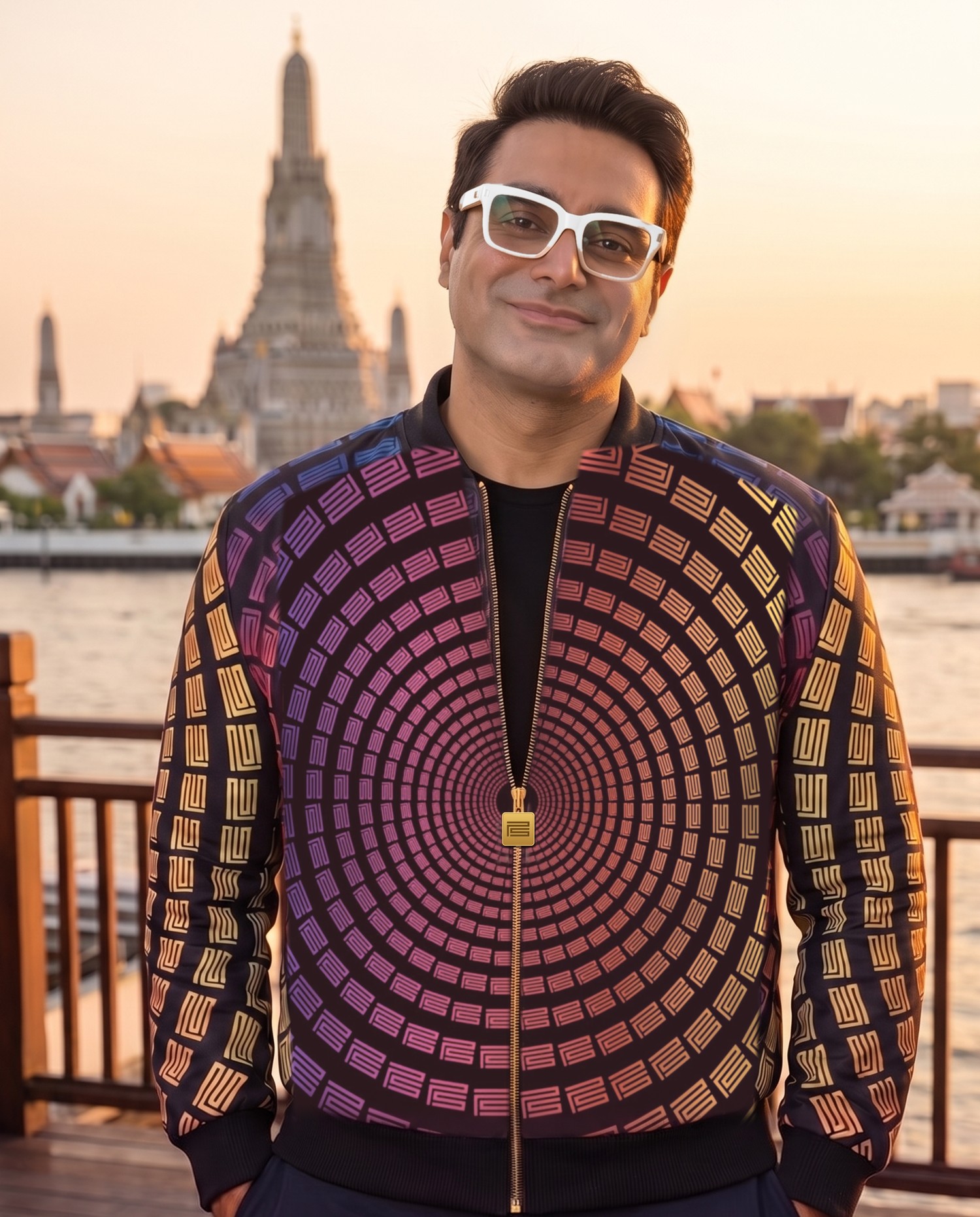
The PS monogram came first — two initials interlocked into a maze. Then someone spun it in a circle, a hundred times over, through every colour there is — and the radial was born: the signature that now runs across every temple, every case, every piece the house produces. See how it is built, and make your own.
Everything the house makes is an edition of thirty-five, individually numbered, never repeated. Not a marketing line — a rule.
Why thirty-five
Because it is written into the mark. P is the sixteenth letter of the alphabet and S the nineteenth: sixteen and nineteen make thirty-five. And count the PS monogram itself: nine gold lines, four black lines and twenty-two turns. Thirty-five again. The number was never picked for scarcity. It was already there, in the initials.
The Founder
Before the frames, there was a stage. Paul Sagoo founded The Asian Awards and spent years putting other people on it.
Born in west London in 1974 to a Sikh family, Paul studied medicine at King's College London — a clinical training he has never quite stopped using. He builds things the way a doctor works: look closely, measure, test, tighten, repeat. It is why a frame that drifts a tenth of a millimetre from its drawing never leaves the bench.
Fashion was always the point. Long before there was a house, it was how he read a room and how he chose to be read: the cut of a jacket, the colour nobody else would wear, the frames that arrive before you do. The awards put him in front of the best-dressed people of a generation; the house is what he learned from watching them.
London made him, and Asia is where he chose to live. Paul now lives in Bangkok, having moved east to live inside the culture he spent years celebrating on stage. It is where the house works from, and where every frame is finished by hand.
He left medicine for business and has spent his career launching, backing and scaling brands. In 2022 Her Majesty Queen Elizabeth II appointed him OBE in her Platinum Jubilee Birthday Honours, for services to the Asian community, to diversity and inclusion, and for his philanthropic work.
Years spent building other people's names. Then one built the way he would want it built himself.
The full story
A life on stage, before the house.
In 2010 he founded The Asian Awards, the annual honours for the global Asian community across business, sport, entertainment, culture and public service. Categories that change with the year, an independent panel — chaired first by Baroness Verma and Lord Wei, and from 2014 by Lord Bilimoria. It ran at the Grosvenor House and then the Hilton on Park Lane, and in February 2027 its tenth edition leaves London for Mumbai. The stage he built has honoured Amitabh Bachchan, Sachin Tendulkar, Shah Rukh Khan and Zayn Malik, and made posthumous awards to Freddie Mercury, Bruce Lee and Mother Teresa. What began as a room of a few hundred became the fixture the diaspora measures itself by.
The Asian Awards
In 2010 he founded the awards that had never existed: a night for the global Asian community, judged on merit, held to the standard of any honour in the world.
The Asian Awards began at London's Grosvenor House Hotel, hosted by Lord Sebastian Coe, and later moved to the Hilton on Park Lane. Its categories span business, philanthropy, sport, science, culture and entertainment — Lifetime Achievement, Fellowship, Entrepreneur of the Year, Business Leader of the Year, and Outstanding Achievement across cinema, music, television and technology. An independent panel decides them: co-chaired at the outset by Baroness Verma and Lord Wei, and from 2014 by Lord Bilimoria.
Amitabh Bachchan took the first Lifetime Achievement in 2010. Sachin Tendulkar was made a Fellow in 2017. Shah Rukh Khan, Zayn Malik and — posthumously — Freddie Mercury, Bruce Lee and Mother Teresa have all been honoured on that stage. What began as a British ceremony for those of Indian, Sri Lankan, Pakistani and Bangladeshi origin opened in 2013 to the whole of South, East and Southeast Asia, and in February 2027 the tenth edition leaves London for Mumbai — its first international staging. The awards partner with Global Citizen on their philanthropic work.
Years of standing at the back of a ballroom watching the most remarkable people of a generation collect a trophy — every one of them, without exception, dressed in black.
Recognition
Honours for the global Asian community, at the Grosvenor House Hotel, hosted by Lord Sebastian Coe. Amitabh Bachchan takes the first Lifetime Achievement.
The Asian Awards open to the whole of South, East and Southeast Asia.
The independent judging panel passes from Baroness Verma and Lord Wei to Karan Bilimoria, Baron Bilimoria.
The Fellowship — the awards' highest honour — to the most capped batsman in the history of the game.
For services to the Asian community, diversity & inclusion, and philanthropy.
The PAUL SAGOO name and PS monogram enter the UK register, filed 31 January, registered 26 April. The maze becomes official.
Commissions open for the first editions of thirty-five: The Square, The Aviator and The Coffret.
The tenth edition, on 5 February 2027 at the Fairmont Mumbai, leaves London for the first time.
The Collection